


Continued support builds momentum for a unique interdisciplinary training program
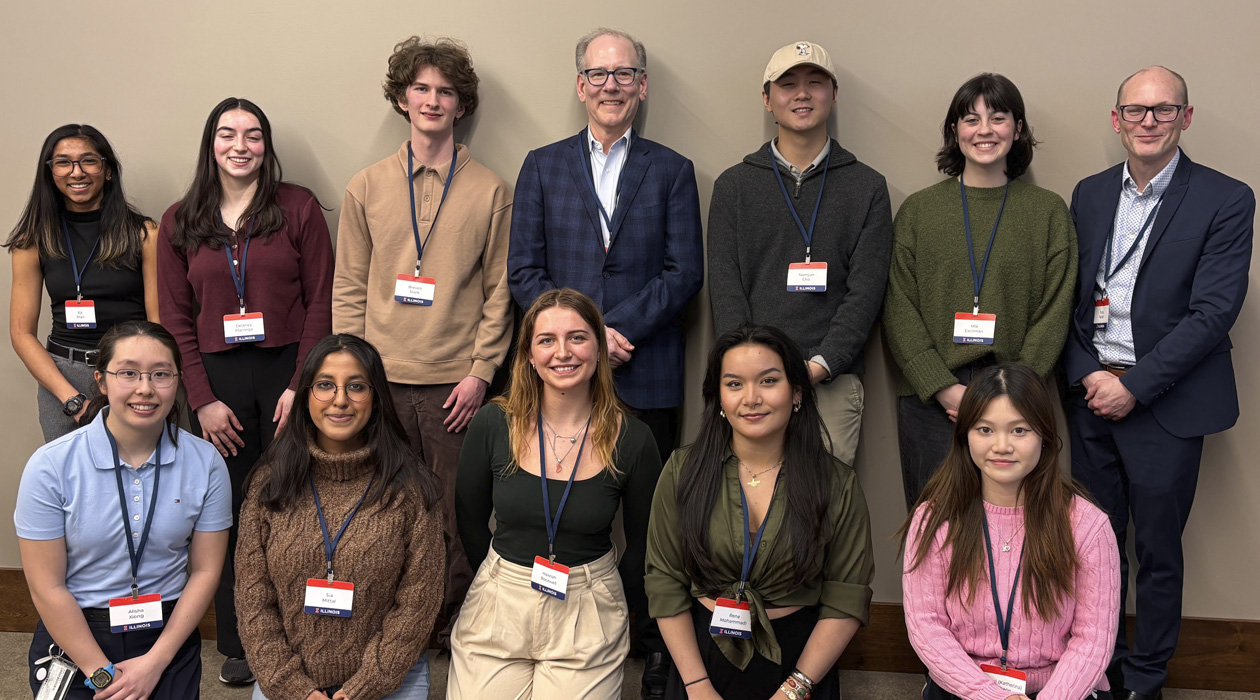
The 2024-2025 Tracy Undergraduate Team Science Training Program cohort, with Mark Tracy (back, center) and Tracy Parish (back, right). / Sarah Schwartz

Share
The grand scale of present-day biological research has made team science a necessity. Career scientists have learned collaborative skills on the fly; last year, with support from Mark Tracy, the Carl R. Woese Institute for Genomic Biology established a program to help train a new generation of interdisciplinary researchers. After a successful first year and with the help of a new gift from Tracy, the Tracy Undergraduate Team Science Training Program will continue to build momentum and extend its reach.
The original gift by Tracy, founder and president of Tracy BioConsulting, LLC and a graduate of the University of Illinois, provided support for two full academic years of the program. His additional commitment will support a further two years, giving course organizer and IGB director of external relations and strategic partnerships Tracy Parish the opportunity to refine and secure additional support for the program.
Tracy was inspired to extend his support after seeing the program and the trainees in action.
“It was really well thought out, not just organized quickly, which is helpful, but implemented and executed in a way that gets that response from the students,” Tracy said. “I was blown away by the students, too, when I had a chance to meet them at the end of the program.”
Rene Mohammadi, who participated in the program’s inaugural year, found that the program offered her a unique training opportunity as she considered how to integrate her academic and research interests.
“As someone who's studying mechanical engineering while researching biomolecular engineering, the concept of "interdisciplinary research" felt intuitive,” she said. “At Illinois, being at the crossroads of two subjects is viewed as an opportunity to push into the future of STEM. By joining this program, I was investing into my future as an engineer-scientist.” Mohammadi graduated in May with a bachelor’s degree in mechanical engineering, and now has a graduate position at the Mayo Clinic investigating early cancer detection methods.
Mohammadi and her fellow training program participants engaged in a variety of training activities throughout the year, including seminars, participatory workshops, and a biotechnology industry site visit. Guest presenters included industry leaders, entrepreneurs, and faculty members from academic research, ensuring that students had access to a broad range of perspectives and expertise.
“I was shocked at how many different career paths we learned about. In undergrad, the two main paths are academia and industry-- but in the program we learned about the in-between, the policy management positions, the science project management positions, and so on,” Mohammadi said. “My excitement for the future grew because of the reassurance that I would find a career path that fit my personality and what I offer to society.”
The program content also specifically emphasized interdisciplinary teamwork skills; students worked through case studies and discussions on topics including effective communication, team problem-solving, and establishing collaborative research projects.
“I realized at my last company before I became a consultant—it was a heavily biology driven company, and before I'd worked for another biotech company that was much more physical science based—it was a different language, a different way of approaching science. It took me a little bit of time to wrap my head around that thought process,” Tracy said. “I learned those skills in the workplace, in multi-disciplinary collaboration . . . if you get that as an undergrad, I think that helps you not only with the scientific process, but as an individual.”
As scientific research faces a moment of uncertainty across all sectors, Tracy also underlined the value of professional experiences to prepare students to make the most of opportunities when they do arrive.
“Pushing the boundaries, experiencing things, taking the opportunities that are available to do things you wouldn't otherwise do, to learn things you wouldn't otherwise learn, you never know when those experiences will be valuable,” he said. "You will not only grow as a person, you will develop unique set of skills that other people may not have. In an era of uncertainty like we have today, that will stand you in good stead.”